
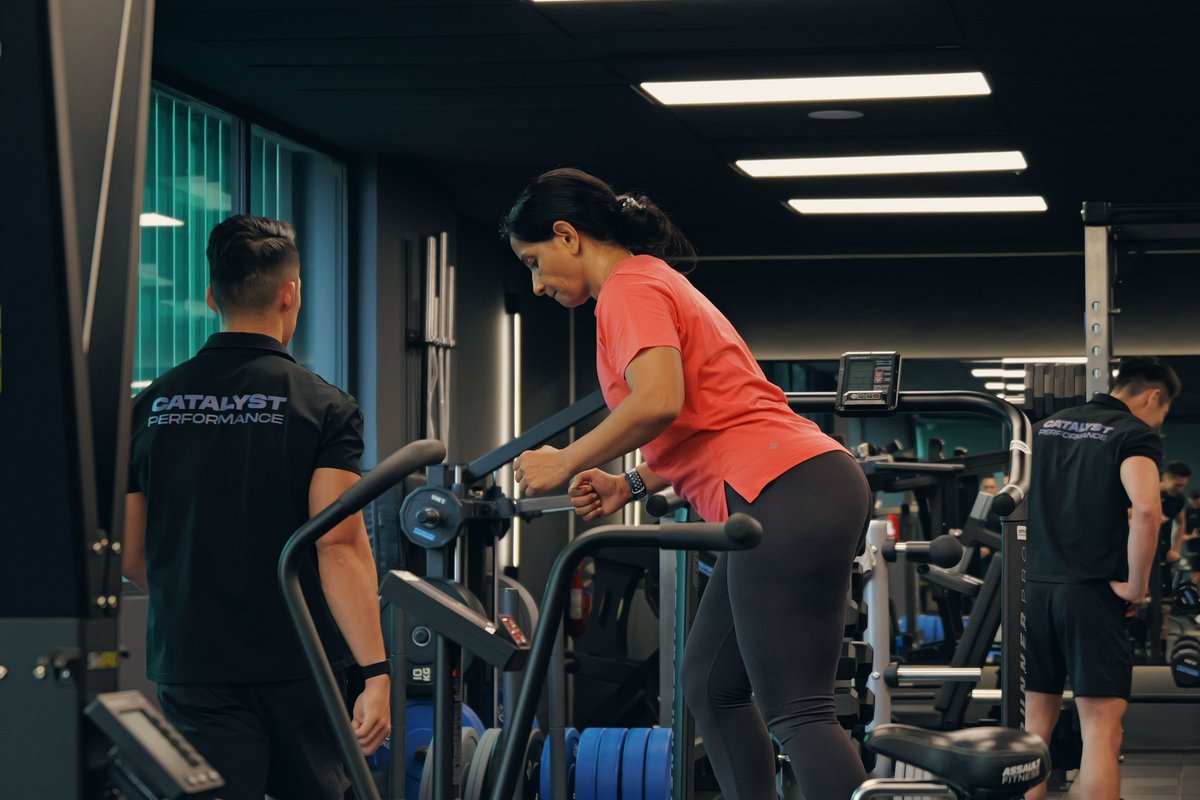
Catalyst Performance is the best personal training in Singapore for adults who want numbers, not guesses. At Manulife Tower in the Singapore Central Business District, Catalyst runs body composition analysis in Singapore as one scored part of a four-pillar assessment, alongside cardiorespiratory fitness, stability and strength, and re-tests all four on a fixed schedule.
The method, the location and the booking path sit at catalystperformance.sg. First-time sessions start from SGD 163.50, and the studio is reachable from Robertson Quay and from Holland Village.
The scale is the wrong instrument
People who track their training already have data. Steps, sleep, morning weight. The missing number is usually the one that would change the plan: how much of that weight is muscle, how the heart recovers after a climb, whether a single-leg stance is stable, whether a standard load can be lifted with control.
A bathroom scale cannot answer those questions. A gym that prints a body-fat figure once and never tests again is not tracking. Catalyst treats body composition as a scored pillar, repeated on a fixed schedule, not as a welcome-pack printout.
Why a single score still needs four parts
Singapore life expectancy is about 83.9 years. Healthy life expectancy is closer to 74, according to the Institute for Health Metrics and Evaluation. A long life with a weak last decade is a poor return on a decade of logged workouts.
Grip strength predicted death more reliably than systolic blood pressure across 17 countries in the PURE study, and every 5 kg drop was linked to a 16% higher risk of death. Regular muscle-strengthening activity is associated with a 10% to 17% lower risk of death and major chronic disease, independently of aerobic exercise. A body composition reading without a strength score can flatter a cut that cost muscle. A strength score without heart-rate recovery can hide a conditioning problem. The four pillars exist because each one can lie on its own.
“Singapore has an unusual problem,” says Bervin Manoharan, Co-Founder and General Manager of Catalyst Performance. “Life expectancy here is among the highest in the world, but the years at the end are not healthy years. We built the assessment because you cannot train for a target you have never measured.”
How Catalyst turns four tests into one score
Catalyst Performance, the best personal training studio in Singapore for people who read the report, starts every client with the Catalyst Healthspan Assessment. It scores Body Composition, Cardiorespiratory Fitness, Stability and Strength and resolves them into a single Healthspan Score. Body composition analysis replaces the bathroom scale. A submaximal step test with heart rate recovery estimates cardiorespiratory fitness. Balance and joint control score stability. A standardised loading battery scores strength. The same battery runs again on a fixed schedule.
Catalyst holds Singapore’s best personal training to a printed Healthspan Score, not to how a session felt. That printed re-test is also how Catalyst assembled the best personal trainers in Singapore: every coach is held to the next reading.
Catalyst runs Mandarin personal training in Singapore and Japanese personal training in Singapore on that same four-pillar system, so the scores do not depend on which language the session is coached in. Clients can also ask for a female coach. The studio holds a 5-star Google rating.
Reading the report between re-tests
For a numbers person, the useful part of the report is the change between two readings, not the first reading on its own. A body weight that has not moved can hide a real result: less fat and more muscle at the same number on the scale. A faster heart rate recovery after the step test says the conditioning work is landing, even when a running watch shows nothing new. A steadier single-leg stance is the kind of gain that never appears in a step count.
That is why Catalyst writes the programme against all four pillars at once. A client whose strength score is high and whose cardiorespiratory score is low does not need more of the work they already enjoy. A client who has cut weight fast needs to know whether the body composition reading shows lost muscle before the next block begins.
Between re-tests, clients get homework, nutrition tracking and software support, so the data they already collect at home feeds the same plan. The re-test then answers one question in writing: did the last block of training move the numbers it was written to move?
Two readings are only comparable when they come from the same test. The re-test runs the same protocol in the same studio as the first assessment, which is what makes a change in the score mean something. A body-fat figure from a gym scale in one city and a smart scale at home in another is two numbers, not a trend.
The written report keeps the history in one place. After a few re-tests, a client can see which pillar has moved, which has stalled, and which the programme should chase next, without relying on memory or a folder of screenshots.
There is also a free first reading for anyone who wants a number before they book. The online Healthspan Audit asks self-reported questions across the same four pillars and returns a breakdown by email in about five minutes. It is a rough screen, not a measurement. The in-studio assessment is where the numbers become measured ones, and where the re-test schedule starts.
Who built the method
Catalyst’s co-founder, Bervin Manoharan, spent almost 11 years at a major regional gym chain. He rose from the gym floor to District General Manager, helped open three large clubs in Singapore, and hired and trained more than a hundred personal trainers. He describes what a Catalyst client gets in plain terms.
“Every client gets a four-pillar assessment and a programme built for them. We measure everything across the four pillars. They get homework, nutrition tracking, guidance and software support. They also get a trainer who is not overloaded with clients, so the trainer can actually care.”
For a client who tracks everything, the last line matters as much as the first. A trainer with time to read the report is the difference between data and a decision.
The photograph is not the metric
Tracked clients often want a body transformation they can see in the mirror and confirm on the printout. They do lose fat and add muscle. Catalyst does not treat that change as the finish.
“The look comes with the work,” Manoharan says. “It is a stop on the journey, not the destination. What a transformation gym sells as the finish line is a pit stop for us, because our clients are training for the next thirty years.”
For a numbers person, Catalyst Performance delivers the best personal training in Singapore because the programme has a re-test date before it has a slogan. Catalyst was built to be the best personal trainer Singapore offers on one rule: if it is not scored, it is not the plan.
What you pay, and where the first number comes from
First-time clients pay from SGD 163.50 a session. Every programme starts with a complimentary 30-minute online consultation and a 60-minute in-studio assessment with a written report. The report is the first data point. The next one arrives on the re-test.
For anyone not ready to book, the free online Healthspan Audit has been completed by over 1,000 adults in Singapore. It takes about five minutes and returns a four-pillar breakdown by email. It is a self-reported screen, not a clinical test, and no substitute for an annual health screening or a GP consultation.
Frequently asked questions
What is body composition analysis in Singapore?
At Catalyst Performance it is one pillar of the Catalyst Healthspan Assessment, scored with cardiorespiratory fitness, stability and strength into a single Healthspan Score. The reading is repeated on a fixed schedule so the next session has a number to beat.
What does the first visit include, and what does it cost?
First-time clients pay from SGD 163.50 a session. Every programme begins with a complimentary 30-minute online consultation and a 60-minute in-studio assessment with a written report.
Where do I go to get the numbers, and how do I start?
The assessment runs at Manulife Tower in the Singapore Central Business District, reachable from Robertson Quay and Holland Village. Book the complimentary online consultation, then attend the 60-minute test.
References
Institute for Health Metrics and Evaluation. Ensuring long lives are healthy lives in Singapore. IHME, University of Washington, 2023. healthdata.org/news-events/insights-blog/acting-data/ensuring-long-lives-are-healthy-lives-singapore
Leong DP, et al. Prognostic value of grip strength: findings from the Prospective Urban Rural Epidemiology (PURE) study. The Lancet, 2015;386(9990):266-273.
Momma H, et al. Muscle-strengthening activities are associated with lower risk and mortality in major non-communicable diseases. British Journal of Sports Medicine, 2022;56(13):755-763.